What Does «Che» Mean in Argentina? (And How to Use it)
If you have ever listened to an Argentine speak, watched an Argentine movie, or simply looked at a map of South American history, you have encountered it: the word «che».
It is the absolute trademark of Argentine Spanish. But what does «che» actually mean? Is it a greeting? A pronoun? A filler word? If you want to sound like a true local on your next trip to Buenos Aires, you need to know exactly how—and when—to use it. In fact, combining «che» with the correct Argentine «vos» conjugation is the ultimate secret to sounding authentic. Let’s break it down.
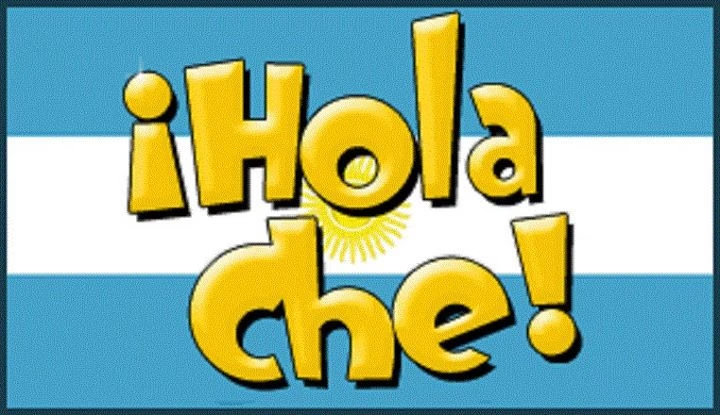
The Quick Answer: What Does «Che» Mean?
In grammatical terms, «che» is a vocative. According to the RAE (Real Acadmia Española) this means it is a word used to directly address someone or get their attention. It doesn’t replace a person’s name; it just accompanies it or stands alone as a general call-out.
Think of how English speakers use «Hey!» before starting a sentence, or how Australians use «mate» at the end of one. That is exactly the energy «che» brings to a conversation in Argentina.
How to Use «Che» Like a True Argentine (With Examples)
Argentines sprinkle «che» into sentences almost subconsciously. Here are the three most common ways you will hear it used in daily life:
1. To get someone’s attention Place it at the beginning of a sentence when you want someone to look at you or listen to what you are about to say.
- “Che, ¿me pasás el mate?” (Hey, can you pass the mate?)
- “Che, Luka, ¿a qué hora nos vemos?” (Hey Luka, what time are we meeting?)
2. To emphasize a point or express surprise You can attach it to the end of a phrase to make your statement stronger.
- “¡Qué calor que hace, che!” (It’s so hot, man!)
- “¡No te puedo creer, che!” (I can’t believe it, bro!)
3. As a casual greeting Often combined with «hola» (hello) or «cómo andás» (how are you).
- “Hola, che, ¿todo bien?” (Hey man, all good?)
Don’t Use It Wrong
Feeling unsure about your ‘pronunciation’Che’? Don’t worry! Book a conversation class with me and practice this word in a safe environment before trying them on the street
The Golden Rule: When NOT to Say «Che»
This is crucial for Spanish learners. «Che» implies closeness, trust, and informality.
Do not use «che» in formal situations. You should avoid it when talking to a police officer, during a formal job interview, or when addressing someone much older than you out of respect (unless they tell you otherwise). If you need to use the formal «usted» with someone, you definitely shouldn’t be calling them «che.»
Where Does «Che» Come From? The Surprising Origins
The exact origin of the word is still debated among linguists, but there are three main theories that make its history fascinating:
- The Mapuche Theory: In Mapudungun (the language of the indigenous Mapuche people of Patagonia), che simply means «people» or «person.»
- The Guaraní Theory: In the Guaraní language (spoken in northeastern Argentina and Paraguay), che means «my» or «mine» (e.g., che amigo means «my friend»).
- The Valencian Connection: In the Valencia region of Spain, people also use «che» (often spelled xe) as an interjection. Millions of Spanish immigrants arrived in Argentina in the 19th and 20th centuries, likely bringing this habit with them.
It is highly possible that modern Argentine «che» is a beautiful mix of all these influences!
Why Was Ernesto Guevara Called «El Che»?

You can’t talk about this word without mentioning the famous revolutionary figure, Ernesto «Che» Guevara.
Guevara was born in Argentina. When he traveled to Cuba to join the revolution alongside Fidel Castro, the Cubans quickly noticed that he used the word «che» in almost every sentence he spoke—a classic Argentine habit. Because the word was so foreign to the Cuban ear, they simply started calling him «El Che» as a nickname, and it stuck forever.
Ready to sound like a true Argentine?
Stop guessing with generic language apps and start speaking real Rioplatense Spanish. I offer 1:1 online classes focused entirely on the grammar, pronunciation, and slang of Argentina. I can help you speak confidently and understand every single che and boludo.
📨 Want weekly Spanish tips?
Get one short email every week with useful phrases, grammar tricks, and Spanish culture insights.