AI or a Spanish Tutor: What’s Better for Learning Spanish?
A few years ago, practicing Spanish required moving abroad or paying for private live classes. Today, you can open ChatGPT or a voice app at 2:00 AM, generate endless grammar drills, and practice chatting in Spanish for free.
Naturally, this raises an obvious question: If AI can explain rules, correct texts, and converse in real time, do you actually still need a Spanish tutor?
As a Spanish teacher, my honest answer is no—you don’t need a tutor for everything. But treating AI as a complete replacement for human feedback is a shortcut that often leads to rigid, artificial speech. Here is what AI actually does well, where it reaches its limits, and how to combine both to reach real fluency.
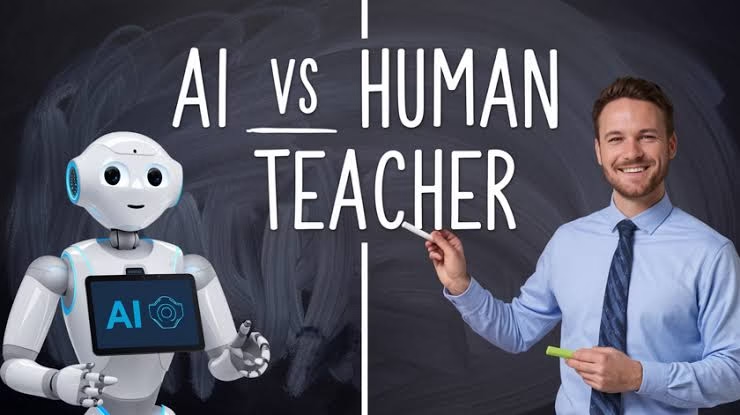
What AI Is Actually Great At (And How You Should Use It)
If you’re already using ChatGPT or language apps to study Spanish, keep doing it. AI is an incredible, low-cost study partner when used for the right tasks. Here is where AI genuinely shines:
Instant Written Corrections:
Feeding ChatGPT a Spanish text or journal entry is great. It catches grammar typos, explains tense choices, and corrects spelling in seconds.
Infinite Grammar Drills:
Need 30 practice sentences to understand specifically the difference between Por and Para? An AI can generate customized exercises instantly without wasting a tutor’s time.
Self-Study for Advanced Readers:
If you already have a strong foundation (B2+) and just want to read, expand vocabulary, and analyze texts, a daily routine with an AI tool is often more than enough.
Where AI Starts to Struggle: The Spoken Fluency Gap
If AI is so good with text, why do so many self-taught students freeze when they try to speak with a native?
Because writing a language and speaking a language use two completely different skills. Here is where relying solely on AI holds back your conversational progress:
Textbook Spanish vs. Real Natural Cadence:
AI voice models speak with artificial, isolated precision. They won’t catch subtle phonetic habits that make you sound like a robot. For instance, in real Rioplatense Spanish, native speakers rarely pronounce «Vamos a jugar» word-by-word; it glides naturally into «Vamoa jugar». AI marks the rigid version as correct, but a human teacher corrects your actual rhythm.
The Spoken Automation Problem:
AI can correct your written essay, but it can’t build your spontaneous speaking reflexes. Many students understand complex grammar on screen, yet panic when ordering food or making small talk because they lack guided, spoken practice.
Regional Reality vs. Dictionary Definitions:
An AI can explain a slang word, but it lacks cultural instinct. For example, It won’t tell you: «Technically that sentence is correct, but no one in Buenos Aires under 60 has said that since 1995.» Real conversational fluency—like mastering how vos works in Spanish or comparing Argentinian vs. Mexican Spanish—requires human nuance.
The Piano Lesson Paradox: Why Most Learners Need Human Guidance
Think about learning to play the piano.
Technically, every single scale, chord progression, and song tutorial is available for free on YouTube. You don’t need a teacher to access the information. So why do people still hire piano instructors? Because of structure, personalized feedback, and accountability.
Without a human guide, it is remarkably easy to get lost in an ocean of content, practice the wrong habits for months, or lose consistency when life gets busy. A tutor doesn’t just teach you grammar; they keep you on track and spot the personal blind spots an algorithm misses.
The Hybrid Approach: Practice with AI, Refine with a Human
The smartest way to learn Spanish in 2026 isn’t choosing between technology or a teacher—it’s combining both:
Use AI for Quantity: Daily vocabulary expansion, reading comprehension, writing checks, and instant drill generation.
Use Human Guidance for Quality: Spoken feedback, natural accent refinement, real conversational reflexes, and consistency.2. Integrate Voseo into Everyday Phrases
🎙️ Need Low-Pressure Weekly Speaking Practice?
Get weekly authentic materials, send voice notes on your own schedule, and receive personalized audio feedback from a native tutor for $30/month.
When Are 1-on-1 Live Lessons Actually Worth Paying For?
While asynchronous practice and AI tools work wonders for building a weekly routine, live 1-on-1 lessons remain the fastest accelerator if:
You need high-intensity speaking practice:
You’re moving to Argentina soon or using Spanish for work and need to build real-time conversational confidence.
You want a 100% custom curriculum:
For specific goals (like mastering business conversations or understanding fast-paced local slang) and a structured plan tailored to your rhythm.
You value instant real-time correction:
Having a teacher right there to guide your pronunciation, catch errors as they happen, and explain cultural nuances on the spot.
In a private lesson, we don’t waste time memorizing tables you could study with AI. We focus on active conversation, building natural fluency, and fixing your specific personal blind spots.
Conclusion: The Smart Learner’s Formula for 2026

Can AI replace a Spanish tutor? No at all, they just do different jobs.
Use AI as your infinitely patient, free practice workbook. But when it comes to spoken naturalness, real-life confidence, and authentic Rioplatense Spanish, complement technology with real human guidance.
🎯 Ready to accelerate your Argentine Spanish?
Book a private 1-on-1 lesson and let’s create a personalized plan to get you speaking naturally and confidently.
📨 Want weekly Spanish tips?
Get one short email every week with useful phrases, grammar tricks, and Spanish culture insights.